كيفية تقليل استهلاك الطاقة في تجفيف صواني البيض؟
Egg tray drying is the most energy-intensive stage in pulp egg tray production, accounting for the largest proportion of total production energy consumption. Rational optimization of drying processes and equipment not only reduces energy costs but also enhances product quality and production efficiency.
Why egg tray drying consume high energy?
After forming, egg trays contain 70%-80% moisture content. Drying is essential to remove this moisture, ensuring structural stability and facilitating storage. Common drying methods include:
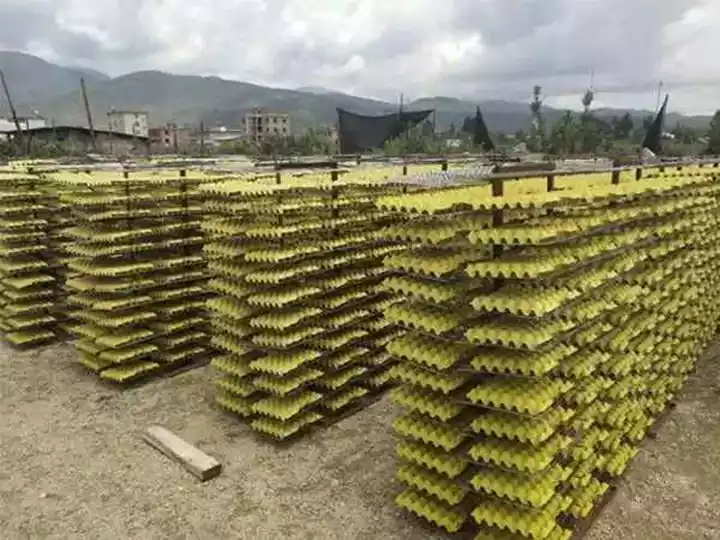
- Natural air-drying: energy-free but slow, highly weather-dependent, unsuitable for large-scale production.
- Brick kiln drying: low investment but uneven heat distribution and significant heat loss.
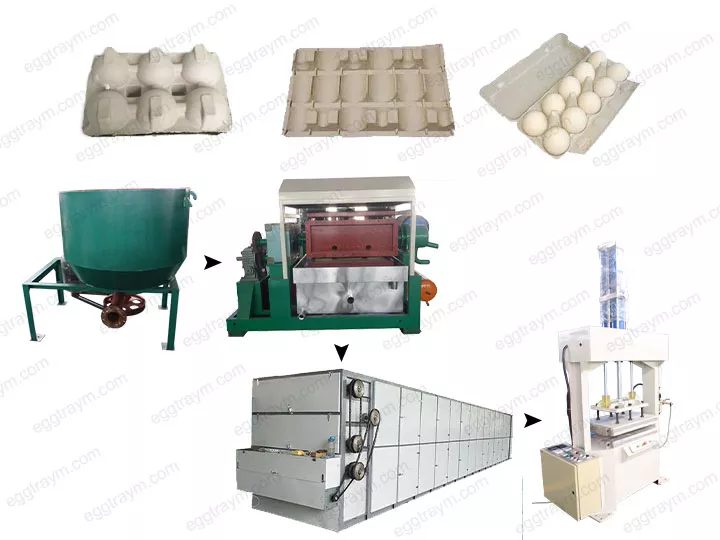
- Continuous drying line: multi-layer stainless steel drying chambers with fan and sensor control. Ensures uniform drying, high efficiency, and 30%-40% lower energy consumption than traditional methods.

Optimizing drying equipment and operations
- Upgrade energy-efficient drying systems: implement automated continuous drying lines for precise temperature and airflow control. This minimizes heat loss and boosts drying efficiency.
- Regular maintenance and calibration: clean fans, seal ducts, and inspect sensors. Prevent heat leakage to ensure stable, high-performance drying systems.
- Optimize stacking and airflow: maintain adequate spacing between egg trays for uniform hot air circulation. Avoid overcrowding, which causes uneven drying and extended processing times.
Pre-drying preparations
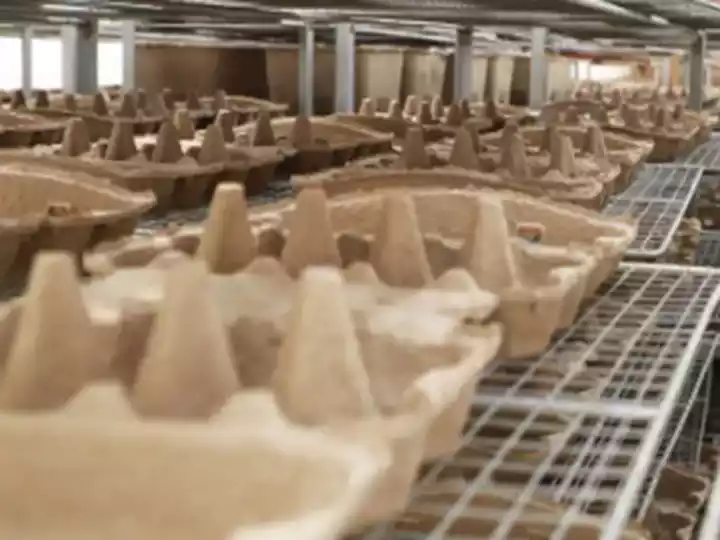
- Adjust pulp concentration: moderate initial moisture content during forming reduces drying load, saving 20%-30% energy consumption.
- Mechanical pressing or vacuum dehydration: pre-removing excess moisture before drying accelerates the process.
- Prevent over-drying: use humidity sensors for monitoring to avoid deformation and energy waste caused by excessive drying.
Energy optimization and sustainability solutions
- Switch to clean energy: replace coal with natural gas or biomass boilers to reduce emissions and enhance combustion efficiency.
- Waste heat recovery: utilize exhaust air heat to preheat intake air, reducing fuel consumption by 15%-20%.
- Combined heat and power: integrate power generation systems to recover excess heat for facility heating or other production processes.
خاتمة
Through rational optimization of egg tray drying equipment, humidity control, improved energy utilization, and waste heat recovery, the drying energy consumption can be significantly reduced. Achieving faster, more uniform, and more energy-efficient drying makes egg tray production both more environmentally friendly and economically viable.